
Millions of people still step on the scale at the doctor’s office, anxious about a single number: their Body Mass Index. But as modern medicine advances, experts are asking a critical question: why is BMI outdated for evaluating personal health? Created nearly two centuries ago for population statistics rather than individual care, this rigid calculation completely ignores muscle mass, body fat distribution, and ethnic diversity.
Contents
- 1. What Is BMI,
and Why Do We Still Use It?
- 1.1. The Real Drawbacks of the BMI Method - why is BMI outdated
- 1.2. BMI & Ethnic Diversity: Key Differences Across Populations
- 1.3. Frequently Asked Questions:
Understanding BMI & Health Metrics
- 1.3.1. Is my BMI wrong, and why does BMI not work for everyone?
- 1.3.2. Why is BMI wrong for muscular women and athletes?
- 1.3.3. Is BMI different for people of color, and why?
- 1.3.4. BMI vs body fat percentage: Which is more accurate?
- 1.3.5. What should I use instead of BMI? (Best alternatives for measuring health)
- 1.4. Key Takeaways: Why Is BMI Outdated & What Matters Instead
Understanding why BMI is outdated allows you to look past a flawed number and focus on metrics that truly measure your wellness.
What Is BMI, and Why Do We Still Use It?
BMI is a simple formula: your weight in kilograms divided by your height in meters, squared. Yet despite its widespread use in clinical settings today, it was never designed to evaluate your personal health status.
The metric was created in the 1830s by Belgian mathematician Adolphe Quetelet—who was not a physician and was not studying obesity. He was attempting to calculate the statistical "average man" using data drawn almost entirely from European men.
It was not adopted as a mainstream medical screening tool until the 1970s, when it was repurposed—not redesigned—for population-level research. A 200-year-old math formula built from one narrow demographic somehow became the default health measurement for every body on Earth.
The Real Drawbacks of the BMI Method - why is BMI outdated
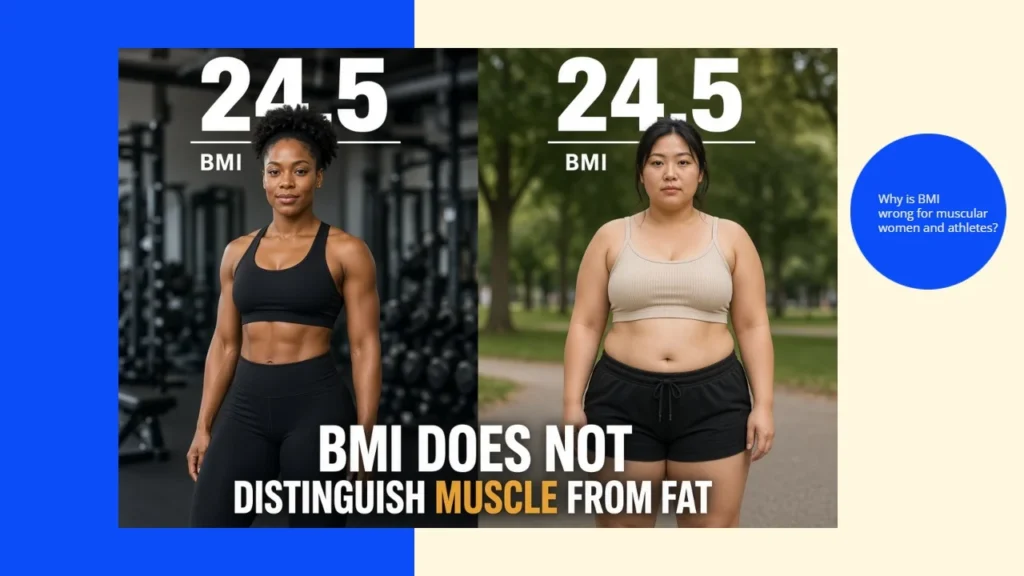
BMI only measures total weight relative to height. It has no mechanism to distinguish lean muscle, bone density, or water retention from body fat. Consequently, a muscular athlete and a sedentary individual of the exact same height and weight land on identical BMI numbers, despite having vastly different body compositions and health profiles.
Research confirms that where fat accumulates—specifically visceral (abdominal) fat around key organs—impacts cardiovascular disease and diabetes risk far more than scale weight alone. BMI is completely incapable of capturing body fat distribution.
Mainstream medical organizations increasingly recognize that BMI was intended as a population-level statistical instrument, not an individual diagnostic tool. Using it in a clinical setting stretches the calculation far beyond its original scope.
Studies evaluating BMI against DXA scans—the gold standard for measuring exact body fat—show that BMI regularly misclassifies individuals as overweight or obese when evaluated against actual body fat percentage. These diagnostic errors occur frequently across multiple demographics.
Standard BMI metrics systematically miscalculate health risks across diverse ethnic populations. For instance, specific Asian populations face elevated metabolic risks at lower BMI numbers, while certain Pacific Islander populations remain metabolically healthy at higher BMI scores. One rigid equation cannot accurately measure every body.
BMI & Ethnic Diversity: Key Differences Across Populations
Asian Populations & "Normal Weight Obesity"
On average, individuals of Asian descent tend to carry a higher body fat percentage at lower BMI values compared to White individuals. This phenomenon—often termed Normal Weight Obesity or "thin outside, fat inside"—means significant metabolic risks like type 2 diabetes can develop even while scale weight remains within "normal" ranges.
- Overweight: ≥ 23 kg/m² (vs. 25 kg/m² standard)
- Obesity: ≥ 25 kg/m² (vs. 30 kg/m² standard)
Black Women: Higher BMI, Different Body Composition
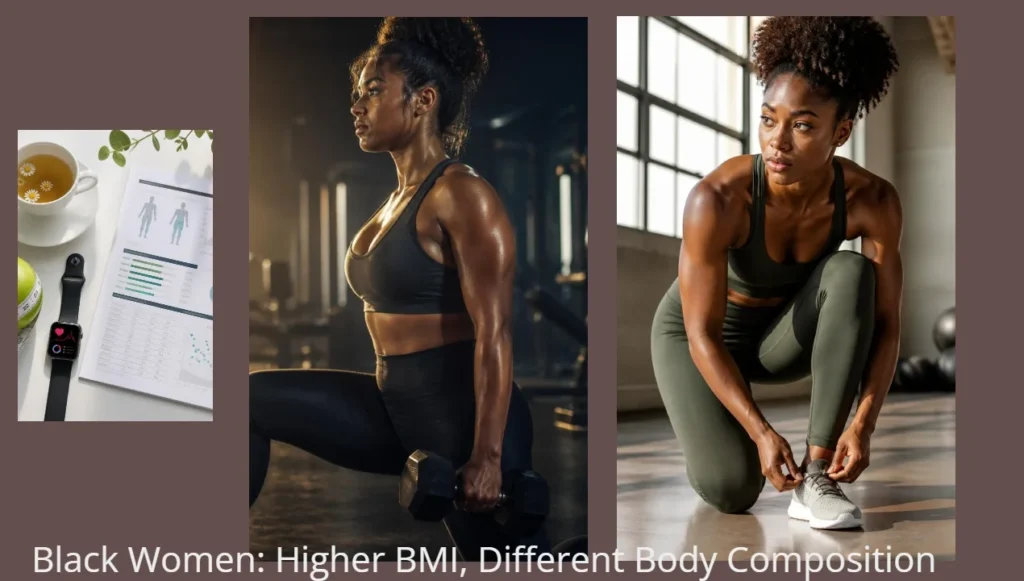
Research consistently shows Black women average higher BMI scores than White women, but this calculation frequently reflects greater lean body mass (dense muscle and bone structure) rather than excess fat tissue. A study published in the International Journal of Obesity highlighted that Black women average 3% to 6% lower body fat than White women at identical BMI thresholds.
Standard calculation methods routinely overestimate fat levels and health risks in this group. CDC data indicates obesity prevalence of 56.9% among non-Hispanic Black women compared to 42.2% for non-Hispanic White women, emphasizing how over-reliance on rigid BMI scales distorts clinical assessments.
Other Diverse Groups: Inuit, Indigenous, & Hispanic Populations
Inaccuracies extend across numerous diverse demographics. In the Inuit population, BMI significantly overestimates overweight status due to a higher ratio of lean mass to height and unique structural proportions (such as shorter legs relative to torso length).
Similarly, Hispanic and Indigenous populations display distinct body fat distributions and muscle composition patterns that deviate sharply from the populations original BMI formulas were calibrated against.
Frequently Asked Questions: Understanding BMI & Health Metrics
Is my BMI wrong, and why does BMI not work for everyone?
BMI (Body Mass Index) can easily misclassify your health status because it only calculates total weight relative to height—it completely ignores what that weight is made of. It cannot differentiate between muscle, fat, bone density, or water retention, making it an oversimplified tool for individuals.
Why is BMI wrong for muscular women and athletes?
Muscle mass is significantly denser than fat tissue. Muscular women and athletes often have high lean muscle mass and low body fat, yet their total weight pushes them into the "overweight" or "obese" BMI categories despite being in peak metabolic health.
Is BMI different for people of color, and why?
Yes. BMI cutoffs were originally developed using data primarily from European populations, failing to account for racial and ethnic variations in body composition. Research shows that populations of South Asian, East Asian, Black, and Hispanic descent face metabolic health risks (like type 2 diabetes) at different BMI thresholds and body fat distributions than white individuals.
BMI vs body fat percentage: Which is more accurate?
Body fat percentage is far more accurate for assessing overall health risk. While BMI only evaluates scale weight, body fat percentage evaluates tissue composition—distinguishing lean muscle tissue from visceral fat, which is the type of fat linked to cardiovascular disease and metabolic dysfunction.
What should I use instead of BMI? (Best alternatives for measuring health)
If you want a clearer picture of your wellness without relying on BMI, consider these alternative metrics:
- Waist-to-Height Ratio: Measures abdominal fat distribution relative to height (aim for a waist circumference less than half your height).
- Body Fat Percentage: Measured via DEXA scans, bioelectrical impedance scales, or skinfold calipers.
- Waist-to-Hip Ratio: Evaluates fat distribution around your midsection versus hips.
- Comprehensive Blood Work: Biomarkers like fasting glucose, HbA1c, lipid panels, and blood pressure offer direct insights into metabolic health.
Key Takeaways: Why Is BMI Outdated & What Matters Instead
Understanding why is BMI outdated is essential for adopting accurate, individualized health measurements. Because the formula relies solely on height and weight, it fails to account for actual tissue composition, fat distribution, or ethnic variations—issues clearly demonstrated when looking at bmi and body composition black women maintain.
Research consistently shows that standard scales overestimate health risks in Black women by mistaking dense muscle and higher bone density for body fat. Moving beyond this 200-year-old calculation opens the door to metrics like waist-to-height ratio, DEXA scans, and metabolic blood work that reflect real wellness.


